Skip to content
minShelfminShelf.com
GroupsFeedHomeAI-dentifyFeedback
Orogenic Gold-Bearing Quartz Vein - minShelf
Orogenic Gold-Bearing Quartz Vein
J
@jcg

Jcg·18 Jun 2026

Orogenic Gold-Bearing Quartz Vein

AI-suggested ID

Provincia Oropeza, Bolivia

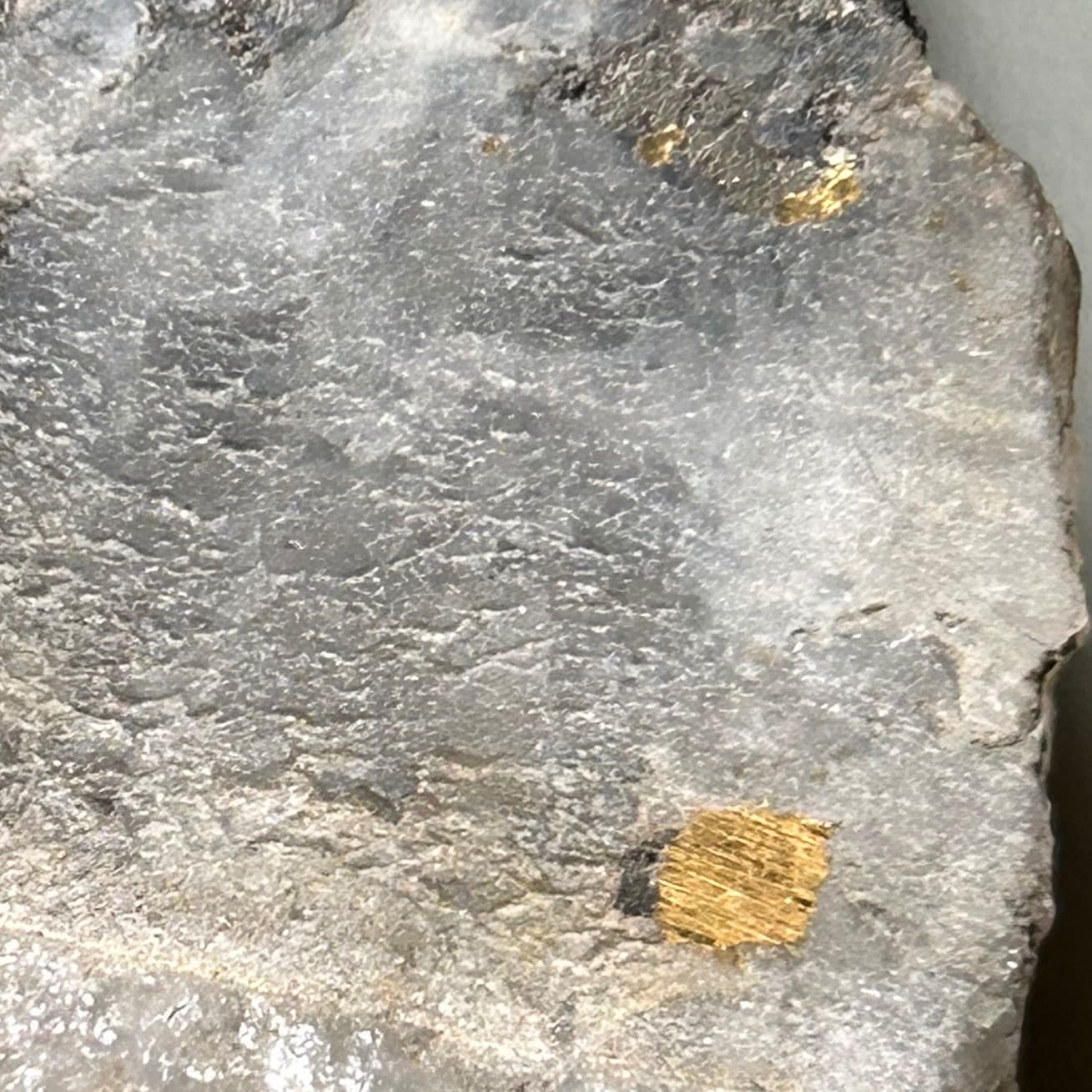
The collector's guess of an orogenic gold-quartz vein is well-supported. The bright yellow, crystalline-textured patches show classic free-milling gold morphology. Confirm with a knife-tip malleability test — true gold will deform rather than crumble. Value depends heavily on gold grade; assay testing is recommended before cutting.

oreself-collected

Formation

Formed by deep-crustal hydrothermal fluids during compressional orogenic events; gold-rich fluids migrated along shear zones and fault systems, precipitating native gold and quartz as pressure-temperature conditions dropped.

Geological origin

Bendigo, Victoria, Australia

Properties

color

grey-white with bright gold patches

grade

Visually high-grade; multiple visible gold patches (bonanza-style)

gangue

Quartz, minor carbonaceous material, possible sulfides

commodity

Native gold (Au)

host rock

Massive to microcrystalline quartz vein in metamorphic/shear-zone setting

alteration

Silicic

Where else to find

Yellowknife, Northwest Territories, CanadaTimmins, Ontario, Canada (Abitibi Greenstone Belt)Kalgoorlie, Western AustraliaHomestake, South Dakota, USAMuruntau, UzbekistanSerra Pelada, Pará, Brazil

Suggested tests

  • • Malleability test: press a knife tip into the gold-coloured patch — native gold deforms; pyrite and chalcopyrite crumble
  • • Streak test: scratch the yellow patch on unglazed porcelain — gold gives a bright yellow streak; pyrite gives greenish-black
  • • Acid test: apply a drop of dilute HNO₃ — gold is unreactive; chalcopyrite will fizz/dissolve
  • • Specific gravity estimate: weigh in air vs. suspended in water — native gold is very dense (~19.3 g/cm³), far denser than common sulfides

Could also be

Chalcopyrite in Quartz Vein - Chalcopyrite (CuFeSâ‚‚) produces brassy-gold patches similar to native gold; distinguished by its greenish-black streak vs. gold's yellow streak and its lower malleability
Pyrite in Quartz - Pyrite is the classic 'fool's gold' look-alike; it typically shows cubic crystals and a greenish-black streak, and is harder and more brittle than native gold
Arsenopyrite with Free Gold - Arsenopyrite commonly co-occurs with native gold in orogenic systems, producing silver-grey matrix with bright metallic flecks; distinguished by garlic odour when struck
primary-source-minedindustrial-electronicollector-museum-speindicator-mineral-go
0

Comments (0)